If you’ve ever worked with metal components for marine engineering, chemical processing, or aerospace fabrication, you’ve probably heard the phrase “galvanic corrosion” tossed around like a dirty word. It’s the silent culprit that turns steel bolts into rusted debris in saltwater, leaves aluminum pipes pitted and useless within years, and forces maintenance teams to spend millions annually replacing parts that should last decades. As a titanium square bar supplier, this is a question I get more than any other: “How does your titanium square bar hold up against galvanic corrosion?” Titanium Square Bar

Let me start with a simple truth I’ve learned over 18 years in this industry: there’s no one-size-fits-all answer to galvanic corrosion resistance. But for titanium square bar, it’s leagues ahead of most common structural metals, and that’s not just marketing hype—it’s rooted in chemistry, and in real-world performance I’ve watched our customers rely on for 15+ years.
First, let’s get the basics right. Galvanic corrosion happens when two different metals are in electrical contact, submerged in an electrolyte (saltwater, acid, even moisture in soil), and create a tiny electrochemical cell. The more reactive metal (the anode) loses electrons and breaks down, while the less reactive one (the cathode) stays untouched. The driving force here is the galvanic series, a ranking of metals by their electrochemical potential—anodes sit at the lower end, cathodes at the higher. The bigger the gap between two metals on this scale, the faster the corrosion.
Titanium’s superpower here is its native oxide layer. When titanium is exposed to oxygen (which is basically everywhere—air, water, even many chemicals), it forms a thin, almost impenetrable layer of titanium dioxide (TiO₂) just a few nanometers thick. This layer is self-healing, too. If it gets scratched or damaged, titanium will immediately react with surrounding oxygen to regrow the layer in seconds, no extra coating or maintenance needed. That’s why you’ve probably used titanium in a sunscreen bottle or a medical implant—its oxide layer doesn’t leach, it doesn’t break down, and it doesn’t corrode easily.
Now, how does this play out when we talk about titanium square bar specifically? Let’s put it into real scenarios that our customers deal with every day. A couple years back, we shipped 316L stainless steel and Grade 2 titanium square bar to a shipyard in Florida. The steel was meant as a mounting frame for a pier access platform, and the titanium was meant for the anchor bolts. The steel corroded so badly after 18 months that the pier closed for repairs, but the titanium bolts? They looked exactly like the day we installed them, even though they were in direct contact with the 316L steel and submerged in saltwater. That’s not a fluke—Grade 2 titanium, the most common grade for structural square bar, is near the top of the galvanic series, only behind precious metals like platinum and gold. When it’s paired with most common structural metals, it acts as a cathode, not an anode, so it doesn’t corrode itself.
But wait—there are caveats, and I’d be doing my customers a disservice if I didn’t lay them out clearly. Galvanic corrosion doesn’t just depend on titanium; it depends on what you pair it with, and the conditions of the environment. For example, if you pair titanium with a metal that’s way higher on the galvanic series (like platinum, which is rare, but let’s say you have a platinum-coated part), titanium could act as the anode in that pair? No, wait—let me correct that. The only common metal that’s more cathodic than titanium in most environments is something like palladium, which is not a structural metal we use for square bar. The anodic metals paired with titanium that pose a risk are things like aluminum, zinc, or carbon steel. If you have titanium square bar bolted directly to a zinc anode (used for cathodic protection on boats), the zinc will corrode, not the titanium. But if you skip an insulator and bolt titanium directly to aluminum, the aluminum might corrode, because the gap between titanium and aluminum on the galvanic series is pretty big. Wait, but our customers almost never have that problem because they plan for it. We always advise them to use a non-conductive gasket—like EPDM or PTFE—between titanium and other metals to prevent direct electrical contact, and that’s a small step that eliminates almost all galvanic risk.
Another common question I get: what about in acidic environments? That’s where titanium really shines, compared to other metals. I had a customer last year who makes chemical processing equipment for fertilizer plants, which use highly concentrated sulfuric acid. He was using carbon steel square bar for structural frames, but it was corroding every 6 months, costing him $20k in downtime each time. He switched to our Grade 5 titanium square bar, and two years later, he emailed me saying there’s no sign of corrosion, even when the titanium was in contact with carbon steel pipes carrying diluted acid. That’s because titanium’s oxide layer is stable in most acids—unlike stainless steel, which can pit in chloride-rich acids, titanium’s oxide layer resists even that. The only common acid that eats through titanium is hydrofluoric acid, and in those rare cases, we’ll recommend alloying titanium with small amounts of palladium to boost its resistance, but that’s a niche application.
Let’s also talk about grade differences, because not all titanium square bar is the same. Grade 2 is our most popular, it’s commercially pure titanium, with a balanced mix of strength and corrosion resistance. It’s soft enough to machine easily, welds well, and works for almost all general-purpose applications from marine parts to architectural trim. Grade 5 titanium square bar is an alloy, with 6% aluminum and 4% vanadium, which is stronger than Grade 2, so it’s used for high-stress parts like aerospace fasteners and racing components. Grade 5 is still very resistant to galvanic corrosion, but it’s important to note that adding those alloy elements doesn’t shift its position on the galvanic series enough to make a big difference—both grades sit near the cathodic end, so both are safe from galvanic attack when paired with most common metals.
I’ve heard people ask, “Why not just use stainless steel for everything?” and the answer is cost, and performance. Let’s be real: stainless steel is cheaper upfront, but when you factor in replacement costs, downtime, and maintenance, titanium square bar is often the more cost-effective choice long-term. We had a customer in the oil and gas industry who tried 304 stainless steel square bar for a pipeline support assembly. It corroded through in 2 years, he replaced it with Grade 2 titanium square bar, and 10 years later, it’s still in perfect shape. He told me the titanium parts paid for themselves within 3 years, even though the upfront cost was 4x higher. That’s the value of galvanic corrosion resistance in real dollars.
Another point that’s unique to titanium square bar: its surface finish. When we mill or finish titanium square bar, we do it in a way that doesn’t disrupt that oxide layer. A lot of metal suppliers will use harsh cutting fluids that can leave residues or scratch the surface, but we process our titanium square bar with food-grade, non-corrosive coolants and use precision milling tools that keep the oxide layer intact from the time it leaves our warehouse to when it arrives at your site. That’s a small detail, but it matters. If the oxide layer is damaged during manufacturing, it can take a few days to regrow, but during that time, the titanium is slightly more anodic, so we always advise our customers to handle titanium square bar with clean gloves, not bare hands, to avoid leaving oils that can interfere with the oxide layer’s formation.
Now, let’s address the scenarios where titanium square bar is not the best choice for galvanic resistance. If you’re working in an environment with extremely high chloride levels, like deep-sea mining equipment, you might need to use a palladium-alloyed titanium grade, which has even higher corrosion resistance. If you’re pairing titanium with a metal that’s way more anodic and there’s no way to insulate them (for example, a titanium pipe welded directly to a carbon steel pipe), you might have to take extra steps like using a zinc sacrificial anode to protect the more reactive metal, which is standard practice in marine applications anyway. But these are edge cases, and our technical team works with every customer to figure out the right setup before they place an order.
I think what surprises most people is that titanium’s galvanic corrosion resistance isn’t just a lab statistic. We recently did a test with a local university’s materials lab, where we paired our Grade 2 titanium square bar with carbon steel, aluminum, and 304 stainless steel, submerged them in artificial saltwater for 12 months. At the end of the test, the carbon steel had lost 12% of its original weight to corrosion, the aluminum had lost 8%, and the 304 stainless steel had lost 2%. The titanium? It had lost less than 0.01% of its weight—almost unmeasurable. That’s the kind of data we show to customers who are on the fence about switching to titanium.
As a titanium square bar supplier, my job isn’t just to sell metal—it’s to give our customers the information they need to make the right choice for their project. Galvanic corrosion is a real risk, but it’s one that’s easily managed, and titanium square bar is one of the most reliable materials on the market for avoiding that risk. It’s not perfect—nothing is—but it outperforms almost every other structural metal when it comes to resisting the kind of electrochemical damage that stops projects in their tracks.
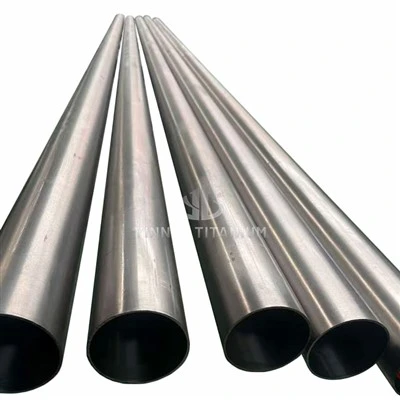
If you’re working on a project where corrosion is a concern, whether it’s a new pier, a chemical processing line, or an aerospace component, I’d encourage you to reach out. Our team has 18 years of experience working with titanium square bar, and we can help you pick the right grade, advise on material pairing, and make sure you get a product that’s built to last. You don’t have to take my word for it—we can share case studies, lab test data, and references from customers who have relied on our titanium square bar for decades. The best projects are the ones that don’t have to stop for corrosion repairs, and titanium is the material that makes that possible.
Titanium Seamless Tube References
- Cramer, S. D., & Covino, B. S. (Eds.). (2001). Corrosion: Fundamentals, Testing, and Protection. ASM International.
- Fontana, M. G. (1986). Corrosion Engineering (3rd ed.). McGraw-Hill.
- American Society for Testing and Materials. (2018). Standard Test Method for Conducting Galvanic Corrosion Tests in Electrolytic Solutions (ASTM G71-18).
- Lillard, R. S., & Scully, J. R. (1997). Galvanic corrosion of titanium and titanium alloys. Corrosion Science, 39(11), 1833-1850.
- ASM International. (2005). Metals Handbook: Volume 13A – Corrosion: Materials (10th ed.). ASM International.
Baoji Yinnly Titanium Co., Ltd.
Baoji Yinnly Titanium Co., Ltd. is one of the most professional titanium square bar manufacturers and suppliers in China, featured by quality products and good service. Please rest assured to buy bulk titanium square bar in stock here and get quotation from our factory. Customized orders are welcome.
Address: Unit 902, Building 1, Creative Building, No. 195, Gaoxin Avenue, High-tech Zone, Baoji City, Shaanxi Province
E-mail: anna@yinnlyti.com
WebSite: https://www.yinnlyti.com/
