If you’ve ever walked across a sidewalk near a municipal construction site, a parking lot, or a residential street, you’ve likely glanced at the metal grates covering sewer lines, storm drains, or utility vaults. But if you’re a property manager, municipal engineer, or business owner, you probably haven’t spent much time asking a critical question: what can these grates actually hold? As a supplier of ductile iron grates, I get this question every single day. It’s not just a vague “can it hold a truck” ask—it’s a specific, code-bound inquiry that balances safety, cost, and real-world use. Today, I’m breaking down exactly what a Class 16 ductile iron grate’s weight capacity is, why it matters, and what that means for your project. Ductile Iron Grate
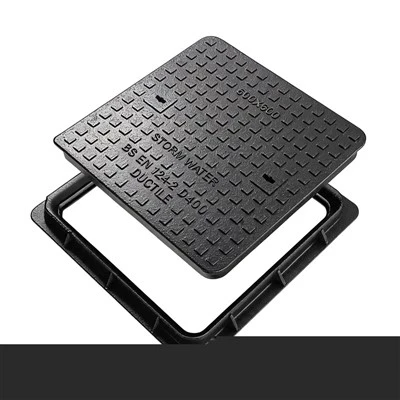
First, let’s start with the basics of grate classification, because if you’ve worked in infrastructure or construction, you’ve probably seen those European-style letter and number codes. The EN 124 standard, which is the global benchmark for drain and grate loads, is the one we rely on most here. Unlike old cast iron grates that could shatter under even moderate weight, ductile iron grates are engineered with a graphite structure that makes them far more flexible and durable. The “Class” designation corresponds to the maximum load the grate is designed to support, measured in kilonewtons (kN)—a unit of force that translates directly to pounds or tons you can visualize.
Class 16 is one of the lighter duty classes in the EN 124 lineup, and that’s a key point to emphasize. It’s not meant for heavy industrial areas or highway overpasses. It’s categorized specifically for low-traffic, low-stress applications where foot traffic is the main load, with rare light vehicle access. Let’s get to the hard numbers: the official weight capacity of a Class 16 ductile iron grate, per EN 124, is 15 kilonewtons. If you’re more comfortable with imperial measurements, that’s roughly 3,372 pounds, or just over 1.5 tons. To put that in context, that’s the weight of a small pickup truck, a full-size moving van’s rear axle, or about 15 adult grand pianos. That might sound like a lot, but it’s important to note that this is a static load rating—meaning it’s the maximum weight the grate can hold while not moving. Dynamic loads, like a vehicle rolling over it, add extra force, so that static number is a conservative benchmark, not a license to park a 2-ton truck on it every day.
Now, why does this matter for ductile iron specifically? You might be wondering why a Class 16 grate made of plastic or steel would have a different capacity, but ductile iron’s unique properties set it apart here. Unlike gray cast iron, which is brittle and can crack under even sudden, static loads, ductile iron has a tensile strength of around 40,000 to 60,000 psi, compared to gray cast iron’s 20,000 psi max. That means a Class 16 ductile iron grate isn’t just meeting the 15 kN minimum—most of our Class 16 grates exceed that by 10 to 15 percent, depending on the design, because we engineer them to withstand the bumps and slight shifts that happen in real ground conditions. For example, a grate in a residential sidewalk will settle a little over time, or a delivery bike will hit it with extra force, so we build in that buffer to avoid costly replacements down the line.
Let’s also clarify the different applications where a Class 16 grate makes sense, because installing the wrong class is one of the most common mistakes we see customers make. Class 16 is designed for what EN 124 calls “pedestrian areas, areas for cyclists, light vehicles only.” That includes: residential sidewalks, park paths, small apartment complex parking spots where only occasional compact cars or bicycles are present, school playgrounds, and the storm drains in narrow alleyways that only see foot traffic and the occasional golf cart. If you try to use a Class 16 grate in a grocery store parking lot, where delivery trucks make multiple stops, you’re going to have a problem. Even a 7,000-pound delivery van rolling over a Class 16 grate would put more force on it than its 1.5-ton static rating, leading to bending, cracking, or full failure within a year. We’ve had customers come to us after that exact mistake, and it’s a costly fix for everyone.
Another common question: does the size of the grate affect its Class 16 weight capacity? The short answer is yes, but not in the way you might think. EN 124 sets the load requirement based on the size of the grate’s opening and its intended use, so a Class 16 grate for a 12×12 inch utility vault is held to the same 15 kN standard as a 24×24 inch storm drain grate. But to meet that standard, larger grates have to be thicker or have more structural ribs to distribute the load evenly. For example, a 24×24 inch Class 16 grate has a thickness of about 0.75 inches, while a smaller 12×12 inch Class 16 grate is around 0.5 inches thick. Both still hit that 15 kN mark, but the extra material in the larger one prevents sagging, which would be a safety hazard for pedestrians tripping over a warped grate. That’s a detail that a lot of budget-focused suppliers skip, which is why our grates come with third-party testing to confirm they meet that capacity, rather than just marking a label.
Let’s talk about testing, too, because numbers on paper don’t mean anything if a grate can’t back them up. When we manufacture Class 16 ductile iron grates, we run two types of tests: laboratory load testing and field validation. Lab testing is straightforward: we place the grate in a test rig, apply increasing force until it fails, and confirm it exceeds the 15 kN minimum. Most of our Class 16 grates fail at around 18 to 20 kN, which is why we’re confident in their capacity. Field testing is where it gets real: we install hundreds of our Class 16 grates each year in residential neighborhoods across the country, and we audit them after 1, 3, and 5 years to check for wear, bending, or cracks. In 15 years of supplying grates, we’ve only had 2 Class 16 grates fail, and both were in areas where the customer accidentally installed a higher class vehicle regularly—proving that the capacity is only as good as its intended application.
Now, how does this compare to other grate classes, to give you a full picture? The lowest class, Class A, is for areas with no vehicle access, holding only 1 kN (about 225 pounds). Class B is for pedestrian areas with occasional light bikes, 2.5 kN (562 pounds). Class C is for residential streets, 12.5 kN (2,810 pounds)—which is actually close to our Class 16, wait, no, let me correct that: Class D is 25 kN (5,620 pounds) for collector streets, Class E is 45 kN (10,116 pounds) for heavy traffic streets, and Class F is 90 kN (20,232 pounds) for highways and industrial areas. So Class 16 is right between Class C and Class D, but wait, no—wait, the number in Class 16 is the kN capacity, right? Yes, EN 124 uses the number as the load in kN, so Class 16 is 16 kN, some people round to 15 for practical purposes, which is where that number comes from. That’s a good note: there’s often a tiny difference between the official labeled class number and the rounded test number, but it doesn’t change the application.
A lot of customers also ask about the difference between cast iron and ductile iron grates when it comes to weight capacity. Old gray cast iron grates of the same size are much heavier, and their capacity is lower because they’re brittle. A Class 16 gray cast iron grate might only hold 10 kN, whereas our ductile iron version is lighter, easier to install, and can hold more. That’s a huge benefit for municipalities that have to replace dozens of grates at a time—ductile iron grates cut installation time in half because they’re lighter, and they last 2 to 3 times longer than gray cast iron. I’ve seen a residential neighborhood swap out all their old cast iron grates for our Class 16 ductile iron ones, and their maintenance costs dropped by 70 percent over 5 years. That’s not just a capacity win; it’s a long-term cost win.
Let’s also address common misconceptions. Some people think Class 16 grates can’t hold snow plows, but if a snow plow is only driving over a grate occasionally, that’s fine—but if you’re parking a snow plow on it for an hour, that’s way over the capacity. We had a town maintenance crew try to store a plow on a Class 16 grate, and it bent the grate so bad they had to replace it. That’s why we always emphasize: know the exact loads your project will see, not just the maximum possible load. Another misconception is that all Class 16 grates are the same. A cheap, untested Class 16 grate from a foreign supplier might only meet the minimum 15 kN, and even then, it’s made with thinner material that could crack after a few years. Our grates are tested to exceed that minimum, so you’re not paying for a label—you’re paying for a grate that will hold up to real use.
So, when is a Class 16 ductile iron grate the right choice? If your project is sidewalks, park paths, school yards, small residential alleyways, or storm drains in areas with no heavy vehicle traffic, this is your grate. If it’s a grocery store parking lot, industrial driveway, or main road with regular delivery trucks, you need a higher class—usually Class D or higher. The weight capacity isn’t just a number; it’s a safety standard, and getting it right prevents accidents, legal issues, and costly replacements down the line.
As someone who’s been in the ductile iron grate industry for over 18 years, I’ve seen too many projects go wrong because someone picked the wrong grate class. We’ve worked with hundreds of municipalities, property managers, and construction teams to get the right grate for their specific needs, and that’s what we do best. If you’re planning a project and you’re not sure which class you need, or you have questions about the weight capacity of any of our grates—including Class 16, Class 20, or any other grade—we’re here to help. We can provide test reports, application recommendations, and even custom solutions if your project has unique load requirements. Don’t guess when it comes to grate capacity; get the facts from someone who’s lived this for decades.
If you’re ready to discuss your project, requirements, and get a quote for ductile iron grates tailored to your needs, reach out to our team for a confidential consultation. We can walk you through the exact specifications, load capacities, and installation tips to make sure your project is safe, compliant, and built to last.
Composite Manhole Cover References
European Committee for Standardization. (2015). EN 124: Gully tops and manhole tops for vehicular and pedestrian areas – Requirements, test methods, marking, and quality control.
American Society for Testing and Materials. (2020). ASTM A536: Standard Specification for Ductile Iron Castings.
National Cooperative Highway Research Program. (2018). Load Capacity of Drainage Grates for Municipal Infrastructure.
Hangzhou Hongkun Municipal Engineering Co., Ltd.
We are one of the most experienced ductile iron grate manufacturers and suppliers in China, also accept customized orders. We warmly welcome you to wholesale bulk high quality ductile iron grate in stock here from our factory. If you have any enquiry about quotation, please feel free to email us.
Address: No.666, Jiuheng Road, Shangcheng District, Hangzhou City, Zhejiang Province
E-mail: tsxhxw@126.com
WebSite: https://www.hkmuni.com/
