Hey everyone, if you’ve ever walked past a manufacturing plant, refinery, or even a big chemical processing facility, you’ve probably glanced up at those giant, skinny towers sticking out of the ground and thought, “How tall is that thing anyway?” As someone who’s been supplying chemical towers for over 12 years, I get this question all the time—not just from random passersby, but from engineers, plant managers, and even new folks in the chemical industry. Let’s break this down without all the stuffy textbook jargon, okay? No boring equations to make your eyes glaze over, promise. Chemical Tower

First off, let’s get one thing straight: there’s no one-size-fits-all answer here. A chemical tower’s height isn’t picked out of thin air (pun totally intended) — it’s tied directly to what you’re using it for. I’ve seen towers barely taller than a two-story house and ones that make a 50-story skyscraper look tiny. Let’s start with the most common types, because that’s where 90% of our orders come from.
Distillation towers, or distillation columns if you wanna be technical, are the workhorses of the chemical industry. They separate different chemicals from a mixture—like turning crude oil into gasoline, diesel, and that stuff we use to make plastic bottles. For small-scale operations, like a lab that does specialty chemical testing, these towers are pretty short—think 20 to 50 feet (that’s 6 to 15 meters, if you prefer metric). When I first started, I helped a university lab with one of these; it was so small, we could roll it into their clean room on a forklift. Cool, right? Now scale that up to a mid-sized refinery or petrochemical plant, and you’re looking at 100 to 200 feet (30 to 60 meters). I installed a distillation tower at a plant in Texas a few years back—total height was 165 feet, and it took our crew a week just to rig it into place because it was so close to their existing equipment. But wait, the big boys? Those giant crude distillation towers you see on the news when a refinery has an outage? They can hit 300 to 400 feet (90 to 120 meters). Yeah, that’s like stacking three 100-foot trees on top of each other. Wild, right?
Next up are absorption towers, which are used to “catch” specific chemicals from a gas stream. Like, say you’ve got a smokestack releasing sulfur dioxide, and you need to scrub that out before it goes into the air. Those absorption towers are usually a bit shorter than distillation ones, mostly because their job is different. Typical heights here are 50 to 150 feet (15 to 45 meters). I worked on a flue gas desulfurization project last year where the absorption tower was 120 feet—we had to build a temporary scaffolding around it just to do maintenance checks, because there was no way to climb it otherwise. It’s not just height, either—absorption towers are often wider too, because they need more surface area for the liquid and gas to mix. That’s why you don’t see them standing as tall as distillation towers; they’re more like thick, tall pillars vs. thin, tall ones.
Then there are the specialty towers—reaction towers, extraction towers, crystallization towers, all the niche ones. These vary even more. A pharmaceutical reaction tower that makes drug ingredients might be 30 to 80 feet (9 to 24 meters), since they’re dealing with smaller, more controlled batches. I sold one to a company that makes insulin precursors a while back; it was only 45 feet, but it had 12 different sensors built in to track every little chemical step. On the other end, a cryogenic distillation tower used to make liquid nitrogen or oxygen for hospitals can be super tall—we did one for a medical gas company that was 275 feet (84 meters). That thing was so tall, we had to schedule its installation around local wind speeds; if it got gusty during the lift, we would’ve had to wait days. Trust me, you don’t wanna try and set a 275-foot metal tower down in a 20 mph wind.
Now, why do these towers get so tall anyway? It’s not just to look impressive (though let’s be real, they do). The main reason is contact time. For distillation, you need the vapor going up and liquid going down to mix enough so that the different chemicals separate—more height means more “trays” or packing material inside, which gives that mixing time. For absorption, you need the gas to pass through the liquid long enough for the chemical you want to dissolve into the liquid. If the tower’s too short, the separation doesn’t work—you end up with a product that’s not pure enough, which defeats the whole point. I’ve had customers try to cut corners by ordering a tower that’s 20 feet shorter than recommended, and it never works. We always push back on that, because we don’t wanna waste their time or money on something that doesn’t do the job right.
Wait, what about height vs. diameter? That’s another thing people ask me. Most chemical towers are tall and skinny, which is the ideal shape for most processes. But some are short and stout—like a 30-foot tall, 20-foot wide extraction tower. That’s for when you need more horizontal contact between liquids, not vertical. So it’s not just the height that matters, it’s the ratio of height to diameter. For distillation towers, that ratio is usually 5:1 to 20:1. So a 100-foot tall tower might be 5 to 20 feet wide. Got it?
Now, let’s talk about real-world examples, because numbers are fine, but actual plants make it real. The Prudhoe Bay Refinery in Alaska has a crude distillation tower that’s 380 feet tall— that’s like the height of the Washington Monument (wait, no, the Washington Monument is 555 feet, so that’s like 2/3 the height of the Monument, still massive). A petrochemical plant in South Korea has an ethylene distillation tower that’s super tall, too—around 410 feet, I think. And the tiny ones? A specialty chemical plant in Ohio uses a distillation tower that’s only 22 feet tall for making fragrance chemicals. I visited that plant once, and the tower fit in the back of their small processing room. It was weird to see such a big job done on such a small scale.
What about factors that change the height even more? Climate, for one. If you’re building a tower in an area that gets a lot of hurricanes or strong winds, you might need to make it a bit shorter or thicker to withstand the wind load. Or if you’re in an earthquake zone, you have to design the height with seismic activity in mind—no wobbly towers, please. We did a project in California a few years back where we had to add extra bracing to a tower that was going to be 140 feet tall, because of the fault lines nearby. That added a few feet to the overall height when we mounted it on the foundation, just to keep it stable. Also, local regulations—some cities or counties have height limits for industrial structures, so you can’t just build a tower as tall as you want. We had a customer in New Jersey that wanted a 250-foot tower, but the local code only allowed 200 feet, so we had to adjust the design to fit their needs within the rules.
Here’s a thing I tell everyone: when you’re looking for a chemical tower, don’t fixate on height first. Focus on what you need it to do—what chemicals you’re separating, what purity you need, how much volume you’re processing. Then the height will come naturally. I’ve had customers come to me asking for a “150-foot tower” because they saw one online, but that’s the wrong way to go. One customer thought a taller tower would be better, but their process only needed 100 feet—so we built a 100-foot tower, saved them money, and it worked just as well. Another customer tried a shorter tower, it didn’t work, and they had to pay us to take it back and build a taller one. Lesson learned.
As someone who’s in the business of supplying these towers, I’ve seen all the heights, all the problems, all the wins. The biggest tower I’ve ever been involved with was 395 feet tall, at a refinery in Louisiana. We had to use three cranes just to lift the sections, and it took our crew 10 days to put it all together. When they fired it up, the refinery’s gasoline purity went up 2%—which might sound small, but it saved them millions of dollars a year. That’s the payoff of getting the height (and the tower) right.
If you’re a plant manager, engineer, or anyone in the market for a chemical tower, let me leave you with this: height is a piece of the puzzle, but it’s not the whole story. The best tower for your operation is one tailored to your specific process, not a one-size-fits-all height. If you’re not sure what you need, hit us up—we’ve been doing this for years, and we can walk you through every part, from height to packing material to design tweaks. No sales pitch, no confusing jargon, just real answers based on what works in the field.
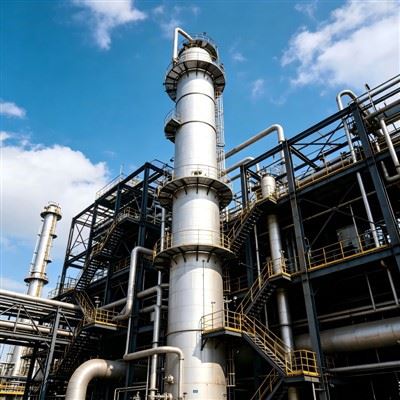
At the end of the day, those chemical towers aren’t just big metal sticks in the ground—they’re the backbone of so many products we use every day, from the gas in our cars to the plastic water bottles we grab on the go to the medicine that keeps us healthy. And their height? It’s all about getting the job done right, one chemical separation at a time. If you’re ready to talk about what you need, reach out to us—we’re here to help you build a tower that fits your process, your budget, and your goals.
Chemical Tower References
- Smith, R. (2016). Chemical Process Design and Integration. Wiley.
- Coulson, J. M., & Richardson, J. F. (2002). Chemical Engineering, Volume 2: Particle Technology and Separation Processes. Butterworth-Heinemann.
- Gas Processors Suppliers Association. (2012). GPSA Engineering Data Book, 15th Edition.
Zibo Gyro Industry Engineering
As one of the most professional chemical tower manufacturers and suppliers in China, we have world-leading production equipment and strong manufacturing capabilities. Please feel free to wholesale advanced chemical tower at competitive price from our factory. Customized orders are welcome.
Address: Jinling San Village, East of Qilu Chemical Industrial Park, Linzi District, Zibo City, Shandong Province
E-mail: vwang5871@gmail.com
WebSite: https://www.gyro-epcunit.com/
