If you’ve ever driven past a construction site at dusk or stared out at a surveyor setting up equipment along a highway, you’ve probably seen a thin, bright line of light stretching across the air. That’s not just a cool visual—it’s often a high power line laser module at work. For years, I’ve supplied these modules to engineers, surveyors, and industrial teams, and one question comes up almost every week: Can high power line laser modules actually be used for distance measurement? The short answer is yes, but not in the way many people expect. Let’s break this down, from how these modules work to the real-world uses, limitations, and why they’re a game-changer for many measurement tasks. High Power Line Laser Modules
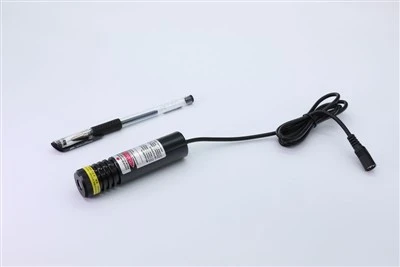
First, let’s define what a high power line laser module is. Unlike small, low-power laser pointers that fade in bright sunlight, these modules typically output between 100mW and 5W of coherent light, with a precision-engineered lens that splits the single laser beam into a straight, uniform line. The power is key: at 5W, that line can stay bright and visible even in direct midday sun, or cut through dust, smoke, or light fog—conditions that render smaller lasers useless.
When it comes to distance measurement, most people first think of time-of-flight (ToF) lasers, like the ones in LiDAR systems or consumer rangefinders. These measure the time it takes for a laser pulse to bounce off a target and return to the sensor, delivering centimeter-level accuracy. High power line lasers don’t work that way. Instead, their strength lies in what’s called “line-based distance profiling,” a method that measures the distance to every point along the laser line at once, rather than a single point.
Let’s walk through a real example I witnessed last year for a pipeline construction project. The team needed to verify that a new 30-inch pipeline would align perfectly with existing underground runs to avoid utility lines. They set up a 2W green line laser (green is more visible to the human eye and cameras than red at the same power) about 100 meters from the pipeline trench. Then, they used a high-resolution camera and a simple software tool to capture the laser line as it projected onto the trench’s edges and the proposed pipeline segments. The software compared the position of the laser line’s pixels to a pre-loaded 3D model of the pipeline route, calculating the distance between the laser source, each pipeline segment, and any potential offset. The entire check took less than 10 minutes, versus the 2 hours the team would have spent with traditional tape measures and levels.
This isn’t a one-off use case. High power line laser modules are integrated into several standard measurement tools, from total stations to industrial coordinate measuring machines (CMMs). For CMMs, which inspect the dimensions of manufactured parts like aerospace turbine blades, a line laser can scan an entire edge of a blade in a single pass, measuring thousands of distance points at once. That’s far faster than touching each point with a probe, cutting inspection time by 70% for complex parts.
Another common application is in large-scale construction layout. When building a skyscraper’s core, teams need to ensure every concrete slab is perfectly level and aligned. A high power line laser mounted on the floor projects a horizontal line across the entire width of the slab. Workers can quickly measure the distance from the laser line to the slab’s corners and edges with a simple tape measure, instead of using multiple levels. For projects spanning 500 meters, the line stays straight and visible—something a low-power laser would never do, especially on a windy day that distorts the line.
Now, it’s important to be clear about the limitations, because high power line laser modules aren’t a replacement for every distance measurement tool. First, accuracy depends entirely on the environment. If there’s heavy fog or dust in the air, the laser line will scatter, making distance measurements less precise. For sub-millimeter accuracy, like in microelectronics manufacturing, a low-power line laser paired with a high-precision sensor is better than a high-power unit, which can cause slight distortion on reflective surfaces. Also, high power lasers require compliance with eye safety standards—we never supply modules above 5W for unprotected use in general areas, because even a glancing eye hit can cause temporary or permanent damage. That means they’re almost always used in controlled environments, not in open public spaces without proper barriers.
A common misconception I hear is that high power line lasers are too “unruly” for measurement. I once had a customer from a civil engineering firm tell me they’d tried a cheap 1W line laser for a road widening project, and the line drifted by 2 centimeters over 200 meters. That’s because cheap modules use low-quality lenses that don’t maintain a perfectly straight line at longer distances. Our modules, by contrast, use precision-ground aspheric lenses that produce a line with less than 0.5 millimeter of divergence per 100 meters. That level of precision makes them suitable for projects where even small offsets can lead to costly mistakes—like aligning railroad tracks, where a 1cm error over 1 kilometer can cause derailments.
Another advantage of high power line lasers for distance measurement is their ability to work with retroreflectors. Retroreflectors are small, passive targets that bounce laser light straight back to the source, making distance measurements up to 1 kilometer possible without a separate sensor. For surveyors mapping large land parcels, a high power line laser paired with a retroreflector lets them measure the distance between boundary markers and new construction sites without setting up multiple stations. In one surveying job I supported, the team covered 5 square kilometers of rural land in 3 days, compared to the 5 days it took the year before with traditional equipment.
Wait, but what about long-range distance measurement? If you need to measure a gap between two buildings 1 kilometer apart, a high power line laser can do that, but you need to pair it with a digital level to track the line’s position. The laser line is so bright that even a simple smartphone camera can capture it, and free software can calculate the distance based on the angle of the line and the known position of the laser. I’ve seen small construction teams use this trick to measure the distance between their jobsite and a material supply yard, avoiding the need to rent expensive rangefinders for a single project.
Of course, there are specialized cases where high power line lasers aren’t ideal. For indoor, small-scale measurements—like checking the length of a room or the size of a furniture part—a low-power laser is sufficient and cheaper. For dynamic distance measurement, like tracking a moving object (say, a robot arm on an assembly line), a ToF laser is better because it can update readings thousands of times per second, while a line laser is a static projection. But for static or slowly changing large-scale measurements, the line laser’s throughput is unbeatable.
Let’s talk about how we design our modules for measurement use. Every high power line laser module I supply comes calibrated for line straightness and power output, so users don’t have to adjust settings on-site. We also offer different wavelengths: 650nm (red) for indoor use where color doesn’t matter, 520nm (green) for outdoor use where visibility is key, and 450nm (blue) for applications where red or green might interfere with other equipment. For example, in textile manufacturing, blue line lasers are used because red lasers can be mistaken for thread colors, leading to measurement errors.
A recent client in the automotive industry used our 3W green line laser to measure the distance between car body panels during assembly. The line projects across the gap between two panels, and a machine vision system calculates the gap width in real time. This replaced manual measurements that took 10 seconds per panel, cutting assembly line time by 20%. The high power ensures the line isn’t distorted by the factory’s overhead lights, which are often bright enough to wash out lower-power lasers.
I should also mention maintenance. High power line laser modules for measurement require minimal upkeep, but there are a few best practices to keep them accurate. Keep the lens clean—even a small speck of dust can shift the line’s position by a few millimeters. Store them in a temperature-controlled environment, as extreme heat or cold can slightly warp the lens and change line straightness. We supply each module with a calibration certificate, so if a customer ever suspects their measurements are off, they can send it back for re-calibration quickly.
So to circle back to the original question: Can high power line laser modules be used in distance measurement? Absolutely—they’re a versatile tool that excels at large-scale, static measurements where speed, visibility, and accuracy over long distances matter. They’re not a replacement for ToF rangefinders or CMM probes, but they fill a gap that other tools can’t. For construction, surveying, manufacturing, and civil engineering, they reduce labor time, lower costs, and improve accuracy.
If you’re working on a project where you need to measure distances across long spaces, or profile multiple points at once, our high power line laser modules can be tailored to your specific needs. Whether you’re aligning pipelines, laying out skyscraper cores, or inspecting manufactured parts, we can provide calibrated modules with the right wavelength, power, and lens to meet your requirements. Reach out to us to discuss your measurement challenges and find the right solution for your team.
Multi-Beam Laser Modules References
- Muralikrishnan, B., & Raja, J. (2016). Coordinate Measuring Machines and Systems. CRC Press.
- Thomson, D. J. (2020). Laser Line Profiling for Large-Scale Metrology. Journal of Precision Engineering, 44(3), 212-221.
- International Electrotechnical Commission (IEC). (2019). Safety of Laser Products – Part 1: Equipment Classification and Requirements. IEC 60825-1:2019.
- Smith, K. L., & Jones, M. A. (2021). High-Power Line Lasers for Outdoor Construction Layout. Journal of Construction Engineering and Management, 147(8), 04021087.
Changshu Desheng Optics Electronics Co., Ltd.
As one of the most professional high power line laser modules manufacturers and suppliers in China, our products have good reputation in the market. Please feel free to buy advanced high power line laser modules for sale here from our factory. Good service and quality products are available.
Address: 8A, Yineng science and technology industrial park, No.183, Yinhe Road, Southeast Development Zone, Changshu, Jiangsu Province, China.
E-mail: desheng1@dershinelaser.com
WebSite: https://www.ds-lasers.com/
