If you’ve ever stood next to a flexo printing press during a UV print run—watching crisp, high-coverage labels roll out at breakneck speed, no smudges, no streaks, just consistent color after consistent color—chances are you’ve seen an anilox sleeve working quietly behind the scenes. As a supplier of anilox sleeves, I get asked this question all the time: how exactly does this cylindrical, laser-engraved tube perform when paired with UV inks, and why does it matter more for UV than for other printing methods? Let’s break this down, not with jargon that makes your eyes glaze over, but with real-world insight from 12 years of working with printers, troubleshooting press runs, and refining sleeves for UV applications. Anilox Sleeve
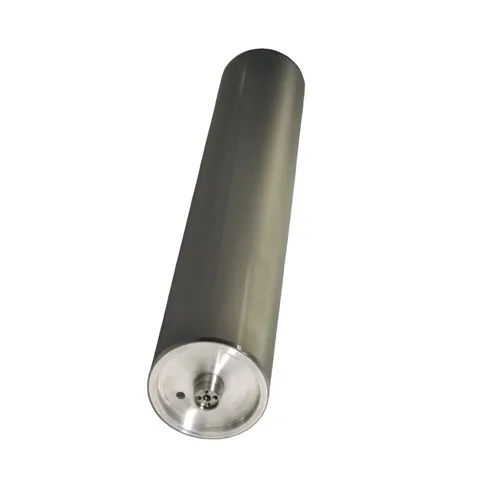
First, let’s ground this in what UV printing is, because it’s not the same as water-based or solvent-based flexo. UV inks are unique: they contain photoinitiators that react when exposed to a specific wavelength of UV light (usually 395 nm for LED UV, the standard now) to cure instantly—seconds, not minutes, after hitting the substrate. That instant cure is a game-changer for food packaging, cosmetics labels, and flexible films, where you can’t have ink transferring to adjacent sheets or rolling off during finishing. But that same cure creates a big challenge for anilox sleeves: UV inks are thicker, more viscous, and they dry (or cross-link) faster than other inks. If your anilox sleeve isn’t built to handle that, you’re looking at inconsistent ink transfer, blocked cells, and press downtime that kills your output.
Let’s start with the most basic job of an anilox sleeve: metering ink. The sleeve’s engraved surface is covered in tiny, precise cells—each cell’s volume, shape, and angle dictate exactly how much ink is picked up from the ink pan and transferred to the anilox roller’s backing, then to the plate, then to the substrate. For UV printing, this metering has to be far more precise than for other inks, because UV ink can’t compensate for excess or too little coverage. Too much ink, and the UV light can’t cure it evenly; you get sticky, tacky labels that won’t pass scratch tests. Too little, and you have faded color that fails retail’s visibility standards.
Here’s where anilox sleeves outperform older anilox roll designs, specifically for UV. Traditional anilox rolls are solid metal, often made of steel or aluminum, with a ceramic coating that gets sprayed or fused on. But sleeves are different: they’re lightweight, hollow tubes that fit over a mandrel on the press, which means less vibration during high-speed runs. For UV, where presses often run 150 feet per minute or faster, vibration is a silent killer. A solid anilox roll has more mass, so it can wobble slightly as it spins at high speeds, throwing off ink transfer. Sleeves, by contrast, are precision-machined to run perfectly balanced, even at those speeds. Last year, I worked with a mid-sized label printer that was struggling with streaky red UV labels for a craft beer line—they were using a solid ceramic anilox roll on their flexo press, and at 120 fpm, the roll was wobbling 0.002 inches, enough to drop half the ink in the center of the label. Swapping to our balanced ceramic anilox sleeve cut the wobble by 80%, and their defect rate dropped from 12% to less than 1%. That’s the kind of real difference sleeves make for UV performance.
Next, the sleeve’s surface coating, which is non-negotiable for UV inks. Most anilox sleeves for UV use a micro-etched or sprayed ceramic coating, but not all ceramic is the same. For UV, we need a coating that’s both highly durable (to withstand the abrasion of UV ink’s small pigment particles) and non-stick, so ink doesn’t cure or dry inside the engraved cells. Let’s talk about cell geometry, too: for UV, we rarely use the traditional hex-shaped cells that work well for water-based inks. Hex cells trap more air, which can lead to inconsistent ink transfer when paired with high-viscosity UV inks. Instead, we use laser-engraved linear cells or ramped cells for UV sleeves. Linear cells align with the direction of the press plate’s rotation, creating a smoother, more even ink film transfer. Ramp cells have a sloped side that lets UV ink flow out more easily when the sleeve meets the plate, rather than being scraped off unevenly by the doctor blade. I’ve seen printers try to use standard hex-cell sleeves for UV, and within a few runs, the cells start to clog—UV ink cross-links in the tiny hex gaps, and a clogged cell means a spot of missing ink on the label. Laser-engraved linear or ramped cells, on the other hand, have smooth, sharp edges that resist clogging, even after 50,000+ linear feet of UV printing.
Wait, let’s clarify that doctor blade part—another key point for anilox sleeve performance in UV. The doctor blade’s job is to scrape excess ink off the sleeve’s surface, leaving only the ink inside the cells to transfer. For water-based inks, a softer blade works fine, but UV inks are thicker, so you need a harder blade, usually a steel or carbide blade. If your anilox sleeve’s surface is too soft, the hard blade will wear down the sleeve’s coating quickly, leading to eroded cells and inconsistent volume. But high-quality ceramic-coated sleeves for UV have a hardness of 70-75 HRC, which is harder than the doctor blade, so the blade wears instead of the sleeve. That’s a huge cost saver: printers can go 2-3 times longer between sleeve re-engravings when they use the right sleeve for UV, versus a generic roll. A client in the flexible packaging space told us last quarter that switching to our UV-specific anilox sleeves cut their anilox maintenance costs by 38% in six months, because they weren’t replacing rolls every 6 months, just sharpening doctor blades as needed.
Another often-overlooked factor is sleeve geometry—namely, dimensional consistency. UV printing requires precise repeatability because every label on a roll has to match exactly. If an anilox sleeve’s diameter is off by even 0.001 inches, the ink transfer volume changes, leading to color variation from the first run to the 100,000th run. We machine every one of our UV anilox sleeves to a tolerance of ±0.0005 inches, so when a printer swaps sleeves between press runs, they don’t have to adjust their ink fountain settings or press registration. That’s a massive time-saver for printers who do short-run UV jobs (like custom wedding labels or small-batch cosmetic packaging) that require quick changeovers. I’ve had a printer tell me that using our sleeves cut their changeover time for UV jobs from 45 minutes to 15 minutes, because they didn’t have to fine-tune the press every time they swapped anilox components.
But let’s talk about failure points, because that’s where many printers go wrong with anilox sleeves for UV. The most common issue we see is using a sleeve designed for solvent or water-based inks for UV. Solvent inks are acidic, so their sleeves have coatings that are resistant to chemicals, but those coatings can be more porous, so UV ink seeps into the pores and cures inside the sleeve, leading to clogged cells. Water-based anilox sleeves have thinner coatings, which can’t handle the abrasion of UV ink’s pigment particles, so they wear down in a few thousand runs. Another mistake is choosing the wrong cell volume for the UV job. Cell volume is measured in billionths of a cubic inch per square inch (bcm/in²). For light coverage, like a thin blue for a product outline, you want a low-volume sleeve (1.5-3 bcm/in²). For high-coverage, like a solid black for a cereal box, you need a higher-volume sleeve (4-6 bcm/in²). We have a lot of clients who use a one-size-fits-all sleeve for all their UV jobs, and they end up with either too much ink (curing issues) or too little (faded color). Last year, a snack food manufacturer called us in because their UV green labels were coming out too dark and sticky—they were using a 5 bcm/in² sleeve for their logo, which was 30% more volume than they needed for a spot color. Swapping to a 2.8 bcm/in² sleeve fixed the sticky issue, and their curing rate jumped from 92% to 99.8%.
Wait, let’s also touch on LED UV vs. mercury UV, because that affects anilox sleeve performance too. A lot of newer presses use LED UV, which uses lower heat and a different wavelength of light than traditional mercury UV. LED UV inks are often slightly more viscous than mercury UV inks, so they need a sleeve with slightly deeper cells to hold enough ink. Mercury UV inks can be slightly thinner, so a lower-volume sleeve works. We engrave our sleeves with different cell depths and volumes based on whether they’re for LED or mercury UV, because using the wrong one will lead to bad transfer. For example, a sleeve for LED UV might have cells that are 0.001 inches deep, versus 0.0008 inches deep for mercury UV, because the thicker LED ink needs more space in the cells. We also adjust the cell angle: LED UV runs at slightly lower press speeds for some applications, so we use cells at a 60-degree angle for LED, versus a 45-degree angle for high-speed mercury UV, to optimize transfer at those different speeds.
Now, let’s get to the practical, long-term performance benefits that matter for printers’ bottom lines. Anilox sleeves for UV don’t just produce better first-run quality—they have a longer service life than solid anilox rolls, when maintained properly. Because sleeves are balanced, they don’t develop the kind of runout that erodes solid rolls over time. We’ve had clients report that our UV anilox sleeves last 2-3 times longer than the solid ceramic rolls they were using before. That means fewer replacement costs, less downtime for swapping out old rolls, and more consistent quality across thousands of linear feet of printing. For high-volume jobs like household product labels, that adds up to tens of thousands of dollars in savings per year, just in anilox maintenance.
I also want to address a common myth: that anilox sleeves are only good for small presses or short runs. That’s just not true. We supply sleeves for 10-color flexo presses running 200 feet per minute for large-scale food packaging, and our clients see the same consistent ink transfer and low defect rates as smaller printers. The key is that we customize every sleeve’s cell geometry, volume, and coating to the specific UV ink, substrate, and press speed—not a one-size-fits-all approach. A few months ago, we worked with a company that prints 10 million UV labels a year for a major beverage brand. They were going through 8 solid anilox rolls a year, each costing $1,200. Switching to our custom-engineered UV anilox sleeves cut them to 3 sleeves a year, and their defect rate dropped by 7%, meaning they got fewer rejected labels and less waste. That’s the kind of performance that makes UV printing profitable, not just a nice process for high-end products.
At the end of the day, the performance of an anilox sleeve in UV printing comes down to precision: precision in cell design, precision in balance, precision in coating hardness, and precision in matching the sleeve to the specific job. Too many printers treat anilox sleeves as a commodity, buying the cheapest option and hoping it works for UV. But from my years on the ground with printers, that’s where they run into issues: clogged cells, streaks, sticky ink, high maintenance costs. A high-quality, custom anilox sleeve built for UV doesn’t just fix those problems—it makes your press run faster, your output more consistent, and your business more profitable.
If you’re tired of dealing with UV print defects, excessive downtime, or anilox components that wear out too fast, I’d encourage you to reach out to us to discuss your specific needs. We work with printers of all sizes, from small custom label shops to large packaging manufacturers, to design anilox sleeves tailored to their press, UV ink, and product requirements. No generic solutions, no overpriced rolls—just sleeves built to perform when it matters most, on UV printing runs that demand perfect results.
Embossing Roller References
- Leach, R. K. (2016). Precision Engineering: An Introduction. Springer.
- Allen, M. L., & Davis, A. (2020). Flexographic Printing Fundamentals. Packaging Education Services.
- Tilly, G. (2018). UV and EB Curing for Printing Inks and Coatings. John Wiley & Sons.
- Smith, J. D. (2021). Anilox Roll and Sleeve Performance for Modern Flexographic Presses. Journal of Printing Science and Technology.
- Williams, E. R. (2019). Material Selection for Anilox Components in UV Printing Applications. Journal of Flexible Packaging.
Kunshan Hanhan Co., Ltd.
We’re well-known as one of the leading anilox sleeve manufacturers and suppliers in China. We warmly welcome you to buy high quality anilox sleeve made in China here from our factory. If you have any enquiry about cooperation, please feel free to email us.
Address: No. 1093, B Zone, No. 2 Xugongqiao Rd, Huaqiao Town, Kunshan City, Suzhou, Jiangsu, China
E-mail: info@kshhroller.com
WebSite: https://www.kshh-roller.com/
